Bell's Palsy, Scottdale, AZ.
A Direct, Gentle Approach to Open Up Restricted Nerve Pathways, Restore Micro-Circulation, and Help You Smile with Confidence Again.
Your Facial Weakness Isn't a Permanent Structural Defect. Your Master Smile Nerve is Simply Trapped in an Emergency Bottleneck.
You look in the mirror and face an incredibly frustrating reality. One side of your face feels heavy, unresponsive, and completely frozen, making it difficult to blink your eye, drink from a glass, or simply smile at the people you love. The sudden loss of control leaves you feeling deeply anxious, self-conscious, and exhausted, forcing you to constantly guard your expression just to get through a conversation.
Standard medical options treat Bell's Palsy with a rigid waiting game: handing you a quick round of steroids or anti-virals in the first few days, and then telling you to just wait weeks or months to see how much of your movement naturally returns on its own.
But simply waiting while a nerve is actively compressed doesn't help the signaling. Even if your facial muscles feel completely unresponsive right now, you can actively change the physical environment to help that nerve wake up and heal.
The Facial Lockdown: Why the Nerve Pathways Freeze Shut
The facial nerve (the cranial nerve responsible for every smile, blink, and expression) has to travel through a microscopic, rigid bony canal at the base of your skull and jaw to reach your facial muscles. When your body experiences an immune flare-up, deep viral stress, or intense systemic fatigue, this narrow highway becomes an instant trap:
-
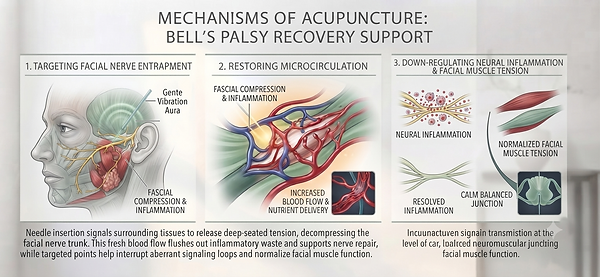
The Micro-Tunnel Gridlock: When the facial nerve becomes inflamed, it instantly expands. Because it is trapped inside a solid bony tunnel, it has nowhere to go. The nerve physically crushes itself against its own canal walls, cutting off its own oxygen supply and causing the electrical signals to your facial muscles to completely drop offline.
-
The Muscular Shock: Because the primary electrical current has been disconnected, your facial muscles enter a state of temporary hibernation. Without regular neurological stimulation, the local tissue begins to lose its natural muscle memory, leading to that heavy, drooping sensation and asymmetrical movement.
-
The Circulation Freeze: When facial movement stops, the natural fluid pump of your face grinds to a halt. Stagnant fluid and metabolic waste pool around the delicate branches of the facial nerve, keeping the environment raw, chemically congested, and sluggish.
How We Decompress the Pathway and Reactivate the Muscle
We do not use aggressive manual tugging or heavy electrical currents that can fatigue a sensitive facial nerve. Instead, we use highly precise, micro-fine acupuncture to place specialized needles directly into the exact motor points of your facial muscles and the primary structural hubs surrounding your ear and jaw. By restoring the native electrical loop, we help guide your face back to symmetry.
-
Step 1: Open the Bony Exit Gates
-
We target the deep, tight muscle and vascular networks right behind the jaw and ear canal. Relieving this local physical compression helps take the pressure off the swollen nerve root, allowing fresh, oxygen-rich blood to return to the wire.
-
-
Step 2: Wake Up Hibernating Muscles
-
We use exceptionally gentle, targeted micro-frequencies to deliver a clear safety signal directly to your dormant facial muscles. This acts like a gentle workout, reminding the muscle fibers how to contract and helping to rebuild your natural smile memory.
-
-
Step 3: Flush Local Fluid Stagnation
-
We clear local micro-circulation and natural lymphatic drainage fields across the cheek, jaw, and neck. This rapidly washes away the trapped chemical waste pool, creating a clean, highly oxygenated environment so the nerve can repair its outer coating.
-
An Intentional Clinical Sanctuary
True neurological recovery cannot be achieved in cold, bright, fast-paced environments. Scottsdale Family Acupuncture is built as a premium sanctuary designed specifically for deep physical down-regulation.
Our private clinical treatment rooms focus on simple, high-contrast, low-stimulation aesthetics. Here, away from the frantic pace of standard clinics, your nervous system is finally given the absolute environment of quiet, dim, and peaceful safety it needs to drop its guarded bracing patterns, calm raw nerve pathways, and fully absorb the benefits of your corrective protocol.
Stop Waiting for the Droop to Clear. Wake Up the Signaling.
You do not have to just sit back and hope your facial nerve recovers on its own. By physically opening up the space around the nerve exit gates, flushing out stagnant fluid congestion, and gently re-educating your facial muscles, we can help you regain natural balance and express yourself with easy confidence again.